Orthorexia
Although this website is primarily about anorexia, I wanted to include a section on orthorexia, a similar disorder that I believe I suffered from.
Orthorexia is an eating disorder defined as an obsession with being healthy. According to The National Eating Disorder Association, it is characterized by restricting one’s diet to solely foods that are deemed healthy, compulsively checking nutritional information and ingredients, and feeling distressed when safe foods are not available. It can also involve an obsession with washing food, sterilizing utensils, or taking vitamins and supplements (Timberline Knolls Residential Treatment Center).
Looking back at my experience, I definitely think some of my behaviors are better defined by orthorexia than by anorexia. While I had the preoccupation with my body shape and weight that is specific to anorexia, I was also obsessed with nutrition and health. My diet was extremely low-fat, low-carb, and low-sugar, I spent hours looking up health benefits or risks of different foods, and I was terrified of specific ingredients, such as high fructose corn syrup or partially hydrogenated oils. My behavior had elements of both anorexia and orthorexia, since I only ate foods and ingredients that I believed were 100% healthy and I believed that not adhering to my food rules would result in immediate and drastic weight gain.
While the most recent edition of the Diagnostic and Statistical Manual of Mental Disorders does not recognize orthorexia as an eating disorder, it is increasingly becoming discussed and many eating disorder facilities offer treatment for it.
There is also debate over whether orthorexia is a type of anorexia, or an entirely different eating disorder. Below are a few similarities and differences between orthorexia and anorexia (Timberline Knolls Residential Treatment Center).
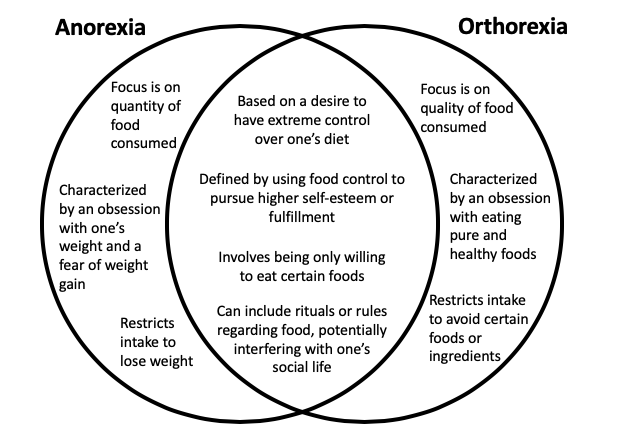
In a society that is increasingly values following diets, counting calories, exercising, etc., it is important to be aware of the physical and psychological effects of orthorexia. Many fad diets have strict rules and routines and they may become unhealthy, despite their initial goal being to increase health.While many people are able to eat healthily without developing an eating disorder, please make sure to seek help if you or someone you know seems to be exhibiting obsessive or compulsive behaviors regarding food or ingredients.